
Bank Statement Converter: PDF and Image Statements to CSV, Excel and JSON
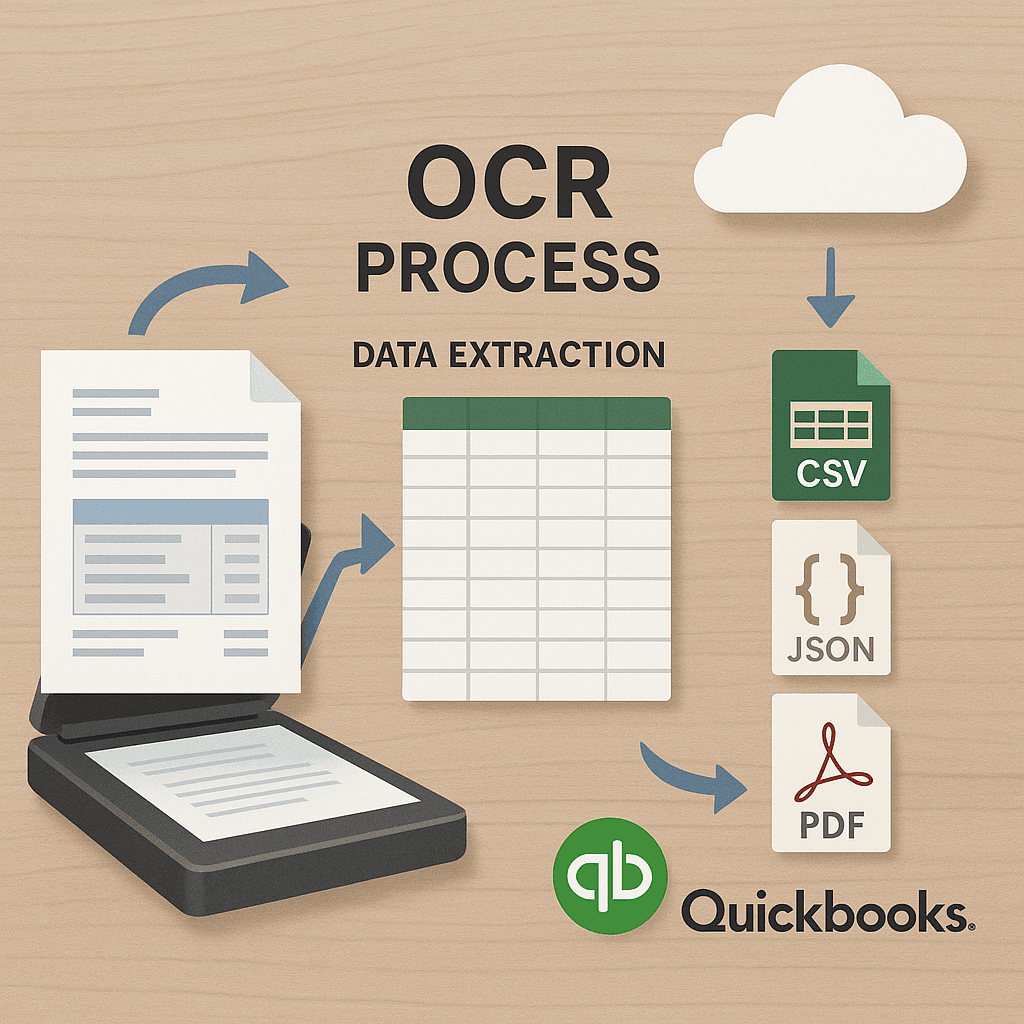
Need to turn PDF or image bank statements into a spreadsheet? A bank statement converter extracts the transactions from a statement you already have and gives you back a structured file — CSV, Excel, JSON, or a QuickBooks-compatible file you import yourself.
This guide covers what these tools do, how to judge one, and where the real differences show up once you are converting statements every month rather than once. It also links out to step-by-step guides for specific banks, card issuers, and output formats.
What a bank statement converter actually does
Banks issue statements as PDFs. Some are digital PDFs with a text layer; plenty are scans or photographs. Either way the data is laid out for a human reading a page, not for a spreadsheet — so getting it into rows and columns by hand means retyping dates, descriptions, and amounts, then checking you did not fat-finger anything.
A converter automates that step. You upload the statement, it extracts the transactions, and you export the result in a format your accounting or analysis workflow can actually use.
Rocket Statements accepts the statement files you already have: PDF files and image files (JPG, PNG) of statements. You do not connect it to your bank to fetch documents — you supply the statement, it gives you back the data.
Who needs one
Bookkeepers and accounting firms. The volume case. Dozens of clients, every month, every format, and every statement has to land somewhere organised and be traceable later.
Tax preparers. Year-end crunch, where statements arrive in bulk and need to become clean summaries fast.
Finance teams and founders. Cash-flow analysis, board and investor reporting, and any month where the numbers need to be in a spreadsheet rather than a PDF.
Anyone reconciling a credit card. Card statements have the same problem as bank statements and the same fix.
How conversion works
- Upload the statement — PDF or an image of one.
- The transactions are extracted into structured rows.
- Check the result before you rely on it. Rocket Statements reconciles the extracted transactions against the balances printed on the statement itself, so an extraction error surfaces instead of passing through silently.
- Export as CSV, Excel, JSON, or a QuickBooks-compatible file.
The original PDF stays alongside the converted file, so any figure can be traced back to the document it came from.
Output formats, and which to pick
| Format | Best for | Notes |
|---|---|---|
| CSV | Importing into other software | Lightweight and universally accepted |
| Excel (XLSX) | Manual edits, formulas, review | Best when a human will work the file |
| JSON | Data pipelines and custom tooling | Structured for programmatic use |
| QuickBooks-compatible | Bringing transactions into QuickBooks | You import the file yourself — see below |
One point worth being precise about: Rocket Statements produces QuickBooks-compatible files that you import. There is no OAuth connection, and it does not push transactions into QuickBooks, Xero, or Sage on your behalf. The file is the handoff. If a tool implies transactions appear in your accounting software without you importing them, check exactly what it means before you rely on it.
You can also re-download the original PDF you uploaded, since the source document is retained — but PDF is not a conversion output. The output is the spreadsheet.
What separates a good converter from a cheap one
At one statement a month, almost anything works. The differences appear at volume.
Errors surface instead of hiding. This is the one that matters most and the hardest to evaluate from a feature list. Extraction output always looks confident — a dropped row or a transposed digit does not announce itself. Rocket Statements reconciles the extracted transactions against the balances printed on the statement, so a mismatch shows up rather than flowing into your books.
The documents stay organised. Converting is half the job; finding the right statement three months later is the other half. Rocket Statements stores documents in the cloud with folders and subfolders, and supports sharing them.
Clients can deliver their own statements. Client portals mean a client uploads directly into the right workspace instead of emailing attachments you then have to file.
The whole team can work in it. Rocket Statements supports team accounts with multiple users, so the work is not trapped in one person's login.
You can trace a number back to its source. Keeping the original document next to the converted file is what makes a figure defensible later.
It meets you where you work. There is a Google Sheets add-on and a Microsoft Excel add-in, so converted data can land directly in the workbook you are already in.
Why this beats pasting statements into an AI chat tool
The realistic alternative for a lot of people is dropping a PDF into ChatGPT or Claude and asking for a table. It works often enough to be tempting.
Where it breaks down is repeatability. There is no per-client organisation, the results live in one person's chat history, nothing is accessible to the rest of the team, the output format drifts between statements, and there is no record of which document produced which figure. And the failure mode is quiet — invented transactions and dropped rows come back in the same confident tone as correct ones.
If you are weighing that trade-off, the verification checklist for AI statement extraction walks through how to check any extraction, whatever tool produced it.
Converting statements from a specific bank
Layouts differ by institution, which is why these guides are bank-specific:
- Bank of America statements to Excel or CSV
- Santander statements to Excel or CSV
- TD Bank statements to Excel or CSV
- Bendigo Bank statements to Excel or CSV
- Coast Capital Savings statements to Excel or CSV
- Bank of Baroda statements into Google Sheets
- HSBC UK statements to Excel or CSV — export, live sync and PDF conversion compared
Converting credit card statements
Card statements have the same problem and convert the same way:
Guides by use case
- PDF bank statements to Excel, for accountants
- Bank PDFs to spreadsheets for a small business
- PDF bank statements to Excel or CSV for tax prep
- CSV bank statements at tax time
- PDF bank statements to CSV online
Frequently asked questions
Can I convert a scanned or photographed statement?
Yes. Rocket Statements accepts image files (JPG, PNG) as well as PDFs.
What can I export to?
CSV, Excel, and JSON, plus QuickBooks-compatible files for manual import. You can also re-download the original PDF you uploaded.
Does it connect directly to QuickBooks or Xero?
No. Rocket Statements produces files you import yourself. There is no OAuth connection and it does not push transactions into those products.
Will it log into my bank and download statements for me?
No. You supply the statement file you already have.
How do I know the extraction is correct?
Extracted transactions are reconciled against the balances printed on the statement, so a discrepancy surfaces rather than passing through unnoticed. Keeping the original document alongside the converted file also means any figure can be checked against its source.
Can my clients upload their own statements?
Yes. Client portals let a client upload directly into the right workspace, and documents are organised in folders and subfolders.
What does the free trial include?
The free trial covers 20 pages, one time and in total. It is not a recurring monthly allowance.
Getting started
Stop retyping numbers out of PDFs. Upload a statement, check the extraction against the statement's own balances, and export it in the format you actually work in.